
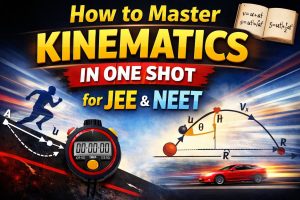
Class 11 Physics ka pehla chapter Kinematics aur tum already soch rahe ho ki yeh toh bahut tough hai? Relax karo yaar! Aaj main tumhe ekdum one shot mein Kinematics master karne ka solid plan deta hoon. Yeh chapter Mechanics ka base hai – agar isko achhe se pakad liya toh baad mein Laws of Motion, Work Energy, Rotational Motion sab aapke liye easy ho jayenge.
JEE aur NEET mein Kinematics se har saal 3-5 questions aate hain (sometimes more in JEE Advanced). CBSE/ICSE boards mein bhi yeh chapter se numericals aur derivations pakke aate hain. Toh chalo, seedha shuru karte hain – no bakwas, only value!
Kinematics Kya Hai? Basic Samajh Lo Pehle
Bhai, kinematics ka matlab hai motion ka mathematical description bina force ke. Yani hum sirf yeh dekhenge ki object kaise move kar raha hai – kitni speed, kitna displacement, acceleration kya hai – lekin force kyun aa raha hai, yeh nahi sochenge (woh next chapter mein aayega).
Important Terms (Clear Kar Lo):
- Rest: Jab position time ke saath change nahi hoti.
- Motion: Position badal rahi ho.
- Distance: Total path length (scalar – sirf magnitude).
- Displacement: Shortest straight line from initial to final position (vector – magnitude + direction).
- Speed: Distance per unit time (scalar).
- Velocity: Displacement per unit time (vector).
- Acceleration: Velocity mein change ki rate (vector).
Common Galti #1: Bahut log distance aur displacement ko mix kar dete hain. Example – ek ladka 3 km east jaata hai, phir 4 km west wapas aata hai. Total distance = 7 km, lekin displacement = 1 km west.
Samajh aa gaya? Ab aage badhte hain.
1D Motion (Straight Line Motion) – Sabse Pehle Yeh Master Karo
Uniform Motion (constant velocity, a=0): s = v × t Yahan acceleration zero hota hai.
Uniformly Accelerated Motion (constant a ≠ 0): Yeh asli king hai! Iske liye humare paas Big 5 Equations hain.
The Famous 5 Equations of Motion:
- v = u + at (Final velocity = initial + acceleration × time)
- s = ut + ½ at² (Displacement = ut + half at square)
- v² = u² + 2as (Velocity square relation – time nahi diya ho toh yeh best)
- s = [(u + v)/2] × t (Average velocity × time)
- sₙ = u + a(2n – 1)/2 (Displacement in nth second – boards aur NEET mein aata hai)
Kaise Yaad Rakhein? Pehle teen sabse zyada use hote hain. JEE/NEET ke 80-90% 1D numericals inhi se solve ho jaate hain.
Derivation Quick Way (Samajh Ke Likho Exam Mein): Acceleration a = (v – u)/t → v = u + at (first equation)
Average velocity = (u + v)/2 Displacement s = average velocity × t → s = [(u+v)/2] t (fourth)
Phir inko combine karke baaki derive kar sakte ho. Graphically bhi samajh sakte ho – velocity-time graph ka area = displacement, slope = acceleration.
Sign Convention – Sabse Important Trick:
- Jo direction motion ki taraf hai, usko positive lo.
- Opposite direction negative. Example: Ball upward throw karo toh u positive, a = –g (g=10 m/s² ya 9.8). Downward mein a = +g.
Bina sign convention ke numerical galat ho jayega – yeh common mistake avoid karo!
Graphs in Kinematics (Visual Mastery)
Bhai, graphs bahut powerful hain – especially NEET aur JEE Mains mein.
- Position-Time Graph: Slope = velocity. Straight line = constant velocity, curved = acceleration.
- Velocity-Time Graph: Slope = acceleration, Area under curve = displacement.
- Acceleration-Time Graph: Area = change in velocity.
Trick: Agar v-t graph straight line hai parallel to time axis → uniform velocity. Inclined line → uniform acceleration.
Projectile ke graphs alag hote hain (niche detail mein batayenge).
2D Motion – Projectile Motion (JEE/NEET ka Favourite)
Ab asli maza! Jab object angled pe throw kiya jaye, toh motion 2D ho jata hai.
Horizontal component: acceleration = 0 → constant velocity ux = u cosθ Vertical component: acceleration = –g → uy = u sinθ, ay = –g
Important Formulas (Ratta nahi, Samajh Ke Yaad Karo):
- Time of Flight (T) = (2u sinθ)/g (jab same level pe land ho)
- Maximum Height (H) = (u² sin²θ)/(2g)
- Horizontal Range (R) = (u² sin2θ)/g
- Maximum Range at θ = 45° → R_max = u²/g
Golden Shortcuts:
- Agar θ = 45°, sin2θ = 1 → range max.
- Do complementary angles (30° aur 60°) ke range same hote hain.
- At highest point, vertical velocity = 0, only horizontal velocity bachi rehti hai.
Equation of Trajectory: y = x tanθ – (g x²)/(2 u² cos²θ) Yeh parabolic path deta hai.
Relative Motion Tricks:
- River boat problem: Velocity of boat w.r.t. ground = vb + vr (vector addition)
- Shortest time crossing: Swim perpendicular to river flow.
- Shortest path: Angle adjust karo taaki resultant perpendicular ho.
Bhai, relative velocity mein sign convention aur vector diagram banana mat bhoolna.
Advanced Tricks to Solve Numericals in 1 Minute
- Check karo acceleration uniform hai ya nahi – agar uniform hai toh hi Big 5 use karo.
- Hidden values dhundo: Question mein “comes to rest” matlab v=0. “Drops” matlab u=0.
- Unit conversion: km/h ko m/s mein badlo (×5/18). Bahut log yahan atak jaate hain.
- Graph method: Agar time diya hai, v-t graph banao – area nikaal lo displacement.
- Free Fall Special: u=0, a=g. s = ½gt², v=gt.
Free Fall Example: Ek ball 80 m height se chhoda gaya (u=0, g=10). Time to ground? s = ½gt² → 80 = 5 t² → t²=16 → t=4 sec. Velocity on ground? v=gt=40 m/s.
Common Mistakes Students Make (Avoid These Warna Marks Gaye!)
- Distance ko displacement samajhna.
- Sign convention bhoolna (especially upward motion mein g negative).
- Formulas blindly apply karna bina condition check kiye (non-uniform acceleration mein nahi chalega).
- Units ignore karna (km/h mein velocity diya ho toh convert karo).
- Projectile mein horizontal aur vertical ko mix karna.
- Average velocity ko instantaneous samajhna.
Ek aur badi galti: “g” ko hamesha positive lena. Upward mein –g, downward +g.
Previous Year Questions (PYQs) Examples with Solutions
JEE Main Style Example: A particle is thrown vertically upward with u=20 m/s. Find maximum height and time to reach highest point (g=10 m/s²).
Solution: At highest point v=0. v = u + at → 0 = 20 – 10t → t=2 s H = ut + ½at² ya v²=u²+2as → 0=400 + 2(-10)H → H=20 m
NEET Style Projectile: A projectile is fired at 45° with u=20√2 m/s. Find range and max height.
Range R = (u² sin90°)/g = (800)/10 = 80 m H = (u² sin²45°)/(2g) = (800 × 0.5)/(20) = 20 m
Relative Motion: Ek boat 5 m/s speed se north ki taraf river cross karna chahta hai (river 3 m/s east). Resultant velocity magnitude?
Resultant = √(5² + 3²) = √(25+9)= √34 m/s
Aise PYQs roz practice karo – last 10 years ke questions solve kar lo.
How to Study Kinematics Effectively (Strategy for 90+ Score)
- Day 1-2: Concepts + all formulas + derivations likho notebook mein.
- Day 3-5: NCERT examples + exercises solve karo (graphs aur numericals).
- Day 6-10: Coaching module ke level-wise questions (easy → moderate → hard).
- Daily Practice: Roz 15-20 numericals. Timer lagao taaki speed badhe.
- Revision: Har Sunday formula sheet revise + 5 PYQs.
- Mock Tests: Full syllabus test mein kinematics section time karo.
Agar tum roz 45-60 minute is chapter pe dedicate karoge toh 2-3 hafte mein mastery aa jayegi.
One Page Formula Sheet (Print Kar Lo):
- v = u + at
- s = ut + ½at²
- v² = u² + 2as
- T (projectile) = 2u sinθ / g
- H = u² sin²θ / 2g
- R = u² sin2θ / g
- g = 10 m/s² (approx for quick calc), exact 9.8
Last Tips for JEE & NEET Aspirants
Bhai, kinematics sirf ratta nahi – samajh aur practice se aata hai. Graphs draw karna seekho, vector diagram banana seekho, aur sign convention ko apna dost bana lo.
Agar koi doubt ho – projectile ke inclined plane wale questions ya circular motion ke initial part – comment mein pooch lo. Main uspe bhi detailed trick article likh dunga.
Ab action lo! Aaj hi ek notebook mein yeh saare formulas likho aur 10 numericals solve karo.
Padhte raho, practice karte raho, aur score laate raho! 💪
Kinematics master karne ke baad next chapter Laws of Motion pe attack karne ke liye ready ho jaoge.
All the best for your JEE 2026 / NEET 2026 preparation!

Sanjeev Kumar (Rishi Sir) is a highly respected Physics educator with 15+ years of teaching experience. A Gold Medalist in M.Sc. Physics, he has taught at leading institutes such as Aakash, Pathfinder, Narayana, and Brilliant Tutorials. He specializes in CBSE, ICSE–ISC, IB, NEET, BITSAT, and IIT-JEE (Mains & Advanced) preparation. Known for his concept-based and result-oriented teaching, he has guided thousands of students to success in board and competitive exams.