
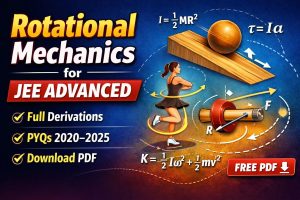
Rotational Mechanics is one of the most important chapters in JEE Advanced Physics. Every year questions are asked from concepts like torque, moment of inertia, rolling motion, and angular momentum. Students preparing for IIT-JEE and NEET must build strong conceptual clarity in rotational dynamics because it connects with other topics like work, energy, and center of mass.
In this complete guide, we will cover Rotational Mechanics theory, key derivations, solved examples, and JEE Advanced PYQ trends from 2020 to 2025.
Students who want to master Physics for competitive exams should practice this topic deeply along with guidance from experienced educators like Sanjeev Kumar (Rishi Sir), known for simplifying complex Physics concepts for JEE and NEET aspirants.
What is Rotational Motion in Physics?
Rotational motion occurs when a body rotates around a fixed axis. Unlike linear motion where objects move in straight lines, rotational motion deals with angles, torque, and angular velocity.
Important quantities in rotational motion include:
Angular displacement (θ)
Angular velocity (ω)
Angular acceleration (α)
These quantities are the rotational counterparts of displacement, velocity, and acceleration in linear motion.
Angular velocity is defined as:
ω = dθ/dt
Angular acceleration is defined as:
α = dω/dt
Understanding these basic quantities helps students solve advanced rotational mechanics problems in JEE Advanced.
Torque – The Turning Effect of Force
Torque is the rotational equivalent of force. It measures how strongly a force can rotate an object around an axis.
Formula:
τ = r × F
Where:
τ = Torque
r = Distance from axis
F = Force applied
If a larger force is applied farther from the pivot point, the torque increases.
In rotational dynamics, Newton’s second law becomes:
τ = Iα
Where
I = Moment of inertia
α = Angular acceleration
This equation forms the foundation for most JEE Advanced rotational mechanics problems.
Moment of Inertia – Rotational Equivalent of Mass
Moment of inertia measures how difficult it is to rotate a body. It depends on the mass distribution relative to the axis of rotation.
Common results used in JEE Advanced:
Ring
I = MR²
Solid Disc
I = ½ MR²
Solid Sphere
I = 2/5 MR²
Hollow Sphere
I = 2/3 MR²
Rod about center
I = 1/12 ML²
Students must remember these standard formulas because they are used frequently in JEE Main and JEE Advanced numerical problems.
Parallel Axis Theorem
The parallel axis theorem helps calculate moment of inertia about a new axis parallel to the center of mass axis.
Formula:
I = Icm + Md²
Where
Icm = moment of inertia about center of mass
d = distance between axes
This theorem is commonly used in problems where objects rotate about edges or external pivot points.
Angular Momentum and Its Conservation
Angular momentum describes the rotational motion of an object.
Formula:
L = Iω
If external torque is zero:
Angular momentum remains constant.
This principle is called Conservation of Angular Momentum.
Examples include:
Ice skaters spinning faster when pulling arms inward
Planetary motion
Rotating platforms
Many conceptual questions in JEE Advanced are based on angular momentum conservation.
Rotational Kinetic Energy
Energy of a rotating object is called rotational kinetic energy.
Formula:
K = ½ Iω²
For rolling motion total energy becomes:
K = ½ MV² + ½ Iω²
Where
MV² = translational kinetic energy
Iω² = rotational kinetic energy
Understanding this energy distribution helps solve rolling motion problems in JEE Advanced.
Rolling Motion – Most Important JEE Topic
Rolling motion combines both rotational and translational motion.
Condition for pure rolling:
V = ωR
Where
V = velocity of center
ω = angular velocity
R = radius of object
Total energy during rolling:
E = ½ MV² + ½ Iω² + mgh
Example result:
Speed of a solid sphere rolling down an incline:
V = √(10/7 gh)
Questions based on rolling motion frequently appear in JEE Advanced Physics papers.
JEE Advanced PYQ Trend (2020–2025)
Based on recent exam papers, the most important rotational mechanics topics are:
Rolling motion on incline
Angular momentum conservation
Moment of inertia calculation
Torque and rotational equilibrium
Energy conservation in rotation
Students preparing for IIT-JEE must solve previous year questions from at least the last 25 years to master these topics.
Best Way to Prepare Rotational Mechanics for JEE
Follow these preparation steps:
-
Understand theory and derivations clearly.
-
Memorize standard moment of inertia formulas.
-
Practice numerical problems daily.
-
Solve JEE Advanced previous year questions.
-
Revise formulas regularly.
Students looking for structured Physics preparation can also explore expert guidance from experienced educators.
Internal Resource:
Best Physics Teacher in India for JEE & NEET
https://bestphysicsteacher.in/best-physics-teacher-in-india-for-jee-neet/
You can also read our guide on:
Top 10 Best Physics Teachers in India for JEE & NEET
https://bestphysicsteacher.in/top-10-best-physics-teachers-in-india-for-jee-neet-2026/
Frequently Asked Questions
Is Rotational Mechanics important for JEE Advanced?
Yes. Rotational mechanics is one of the highest weightage chapters in JEE Advanced Physics and appears almost every year in the exam.
Which topics in rotational mechanics are most important?
Important topics include torque, rolling motion, angular momentum conservation, and moment of inertia.
How many questions come from rotational mechanics in JEE?
Usually 1–2 questions appear directly or indirectly from rotational mechanics in JEE Advanced.
Who is the best physics teacher in India for JEE preparation?
Many educators teach Physics for JEE, but students often look for concept-focused teachers who simplify difficult topics and provide deep conceptual understanding.
What is the best way to master rotational mechanics for JEE 2026?
The best strategy is to understand derivations, practice numerical problems regularly, and solve previous year JEE Advanced questions.
Conclusion
Rotational Mechanics is a core topic in JEE Advanced Physics preparation. Students who understand the concepts of torque, moment of inertia, rolling motion, and angular momentum can solve even the most challenging problems.
Consistent practice, concept clarity, and guidance from experienced teachers will help aspirants achieve strong scores in Physics.

Sanjeev Kumar (Rishi Sir) is a highly respected Physics educator with 15+ years of teaching experience. A Gold Medalist in M.Sc. Physics, he has taught at leading institutes such as Aakash, Pathfinder, Narayana, and Brilliant Tutorials. He specializes in CBSE, ICSE–ISC, IB, NEET, BITSAT, and IIT-JEE (Mains & Advanced) preparation. Known for his concept-based and result-oriented teaching, he has guided thousands of students to success in board and competitive exams.